Antenner

Antenner – En central rolle i kommunikationsteknologier
Antenner er elektriske enheder, der bruges til at modtage eller sende elektromagnetiske bølger, såsom radiobølger, tv-signaler, mobiltelefonsignaler, trådløse netværkssignaler og meget mere.
Multiband antenner til industrielle formål anvendes i trådløse kommunikationssystemer, hvor der stilles høje krav til stabilitet, dækningsområde og miljørobusthed. Antennetype er designet til at understøtte flere frekvensbånd og muliggør dermed kommunikation på tværs af forskellige trådløse teknologier og netværksstandarder.
Antennen har typisk et omnidirektionelt strålemønster, som sikrer ensartet signaludbredelse i alle retninger. Dette er en fordel i installationer, hvor antennens orientering kan variere, eller hvor der kræves stabil forbindelse uanset enhedens placering. Den brede frekvensunderstøttelse giver fleksibilitet ved både eksisterende og fremtidige systemudvidelser.


Leverandører af Antenner:
DeltaM2M ApS

Kratbjerg 240
3480 Fredensborg
Tlf.: 48480148
E-mail: info@deltam2m.dk
Develco A/S

Hedeager 40
DK-8200 Aarhus N
tlf.: +45 87 400 300
E-mail: info@develco.dk
MALMBERGS

Generatorvej 14
2860 Søborg
Tlf.: 44 50 03 77
E-mail: info@malmbergs.dk
Phoenix Contact A/S

Hammerholmen 43 C
2650 Hvidovre
Tlf.: 36 77 44 11
E-mail: kundeservice@phoenixcontact.dk
S-CONNECT ApS

Voldbjergvej 12A, ST
8240 Risskov
Tlf: 86 99 79 96
Mail: info@s-connect.dk
Schneider Electric Danmark A/S

Lautrupvang 1
2750 Ballerup
Tlf.: 88 30 20 00
Tormatic AS

Skreppestadveien 24
3261 Larvik
Norge
Tlf.: +47 33 16 50 20
E-mail: info@tormatic.no
Mere viden om Antenner:
Antenner spiller en central rolle i kommunikationsteknologier og er afgørende for at overføre og modtage information over trådløse forbindelser. Alt indenfor ca. 10 bølgelængder, kaldet nærfeltet af en antenne, kan påvirke dens udstrålingsdiagram og fødeimpedans. Antenner er mest "påvirkelig" i dens hovedkegler, dér hvor den har størst "forstærkning" i et fritfelt udstrålingsdiagram.
Antenner fungerer ved at omsætte elektriske signaler til elektromagnetiske bølger, der udbredes i luften og kan transportere information over lange afstande uden behov for fysiske ledninger. De er designet til at have bestemte egenskaber og retningsmønstre, der gør dem velegnede til specifikke applikationer.
Der er mange forskellige typer af antenner afhængigt af deres anvendelse og design.
Nogle af de mest almindelige typer inkluderer:
- Dipolantenne: En simpel antenne bestående af to ledninger eller stænger, der strækker sig i modsatte retninger fra en fælles punkt. Dipolantenner bruges ofte til radio og tv-modtagelse.
- Parabolantenne: En antenne, der består af en parabolformet reflektor og en fokuseret punkt eller stråle, der bruges til satellitkommunikation og tv-modtagelse.
- Yagi-antenne: En retningsbestemt antenne med en række stænger i en bestemt konfiguration, der giver en øget forstærkning og en smal retningsmønster. Yagi-antenner bruges ofte til tv-, radio- og trådløse netværkssignaler.
- Patch-antenne: En flad, kompakt antenne ofte anvendt i trådløse kommunikationssystemer, såsom Wi-Fi-routere og mobiltelefoner.
- Helicalantenne: En spiralformet antenne med en forvrænget stænger, der giver en retningsbestemt stråling. Helicalantenner bruges ofte i trådløse kommunikationssystemer og satellitkommunikation.
Antenner kan have forskellige retningsmønstre, såsom omnidirektionel (udsender eller modtager signaler i alle retninger) eller retningsbestemt (fokuseret stråling i en bestemt retning). Valget af antennen afhænger af specifikke krav og applikationer, der kræver signaludbredelse eller -modtagelse.
Udover kommunikation bruges antenner også i forskellige andre applikationer, såsom radarteknologi, radioudstyr, trådløse fjernbetjeninger og radioastronomi for at opfange elektromagnetiske signaler fra rummet.
Robuste antenner til krævende miljøer


Robuste antenner til krævende miljøer
M2M Nordic - Kommunikation og overvågning af kloaknet, vandmåling og oversvømmelseshåndtering stiller særligt høje krav til det tekniske udstyr.
Installationerne placeres ofte i brønde, pumpestationer og andre miljøer, hvor fugt, kemikalier og periodisk nedsænkning er en del af hverdagen. Her er det afgørende, at kommunikationsudstyret, herunder antennerne er designet til at kunne modstå de ekstreme forhold, også over tid.
Vi tilbyder nu to specialudviklede antenner, der er målrettet netop disse udfordrende applikationer: LPBSC-6-60 og B4BSC-6-60 (sidstnævnte leveres inkl. vinkelbeslag). Antennerne er kompakte, korrosionsbestandige og IP68-klassificerede, hvilket betyder, at de kan nedsænkes i op til 5 meters dybde i op til 7 dage uden at gå på kompromis med ydeevnen.
Antenneløsningerne dækker et bredt frekvensområde fra 617–960 MHz og 1427–6000 MHz og understøtter dermed både eksisterende og fremtidige kommunikationsteknologier. Det gør dem velegnede til 2G, 3G, 4G og 5G samt NB-IoT, CAT-M1 og LoRaWAN. Den omnidirektionelle dækning sikrer en stabil forbindelse i alle retninger, selv i komplekse installationsmiljøer.
Antennerne er udført i 316 rustfrit stål, som giver høj modstandsdygtighed mod korrosion, og de er udstyret med indbygget dobbelt-afskærmet kabel samt IP68 SMA-stik. Med en kompakt højde på blot 82 mm er de nemme at integrere i teknikskabe og brønde, og de kan monteres fleksibelt på væg, panel, kabinet eller mast.
Begge modeller lagerføres og kan leveres direkte fra M2M Nordic, klar til krævende opgaver i forsynings- og spildevandssektoren.
TME – Muligheder og typer af Kyocera AVX-antenner

TME – Muligheder og typer af Kyocera AVX-antenner
Engelsk: Wireless communication is not only the domain of consumer devices such as smartphones and tablets. Practically, almost every IoT circuit communicates using one of the popular standards: Wi-Fi, Bluetooth, LTE or ZigBee. However, the strength of the radio signal, and thus the data transmission range and rate, are not only dependent on the module used in a given device – choosing the right antenna is also a vital factor...
The Kyocera AVX assortment of antennas is an extension of the offer that was formerly marketed by Ethertronics (which is now part of the Kyocera AVX Group). These are top-quality, highly specialist components designed to be operated using popular communication standards. They are designed with compact size, mechanical robustness and IoT applications in mind. These include industrial equipment for the transmission of M2M (Machine-to-Machine) data.
Wi-Fi/Bluetooth antennas
Most devices using Wi-Fi and Bluetooth BLE connectivity are miniaturised circuits. They communicate over short distances (usually up to several metres) and have to be equipped with the most compact antennas possible. Fortunately, the standard transmission frequencies of these communication standards (2.4 GHz and 5 GHz) allow the construction of microscopically sized radiators, e.g. ceramic elements enclosed in SMD packages. Such antennas are, naturally, available from the Kyocera AVX range. Their case is a 2x1.2x0.55 mm cuboid (selected models). The energy gain of such components falls within the range of 1–4.4 dBi. They offer superb omnidirectionality, as illustrated below. This ensures that the signal level (of the typical linear polarisation) is not affected by the spatial orientation of the circuit.

The Kyocera AVX assortment includes SMD antennas which can be embedded in a PCB (i.e. "demo" versions), fitted with a coaxial SMA connector. These are excellent aids to facilitate circuit prototyping and testing stages.
The manufacturer also provides solutions catering for devices that require the antenna to be placed away from the circuit for optimum positioning. This may be necessary, for example, in the case of embedded sensors or controllers housed in a switch cabinet. Solutions designed for such applications include antennas placed in sealed enclosures with factory-fitted connection cables (1 m, SMA plug).
Keep in mind that antennas intended for the 2.4 GHz band are compatible not only with Wi-Fi networks and Bluetooth modules, but also with a number of other communication standards, e.g. ZigBee.
GNSS antennas
The GNSS acronym stands for Global Navigation Satellite System. The first widely used solution of this type (and which is still the most popular one) is, needless to say, the American Navstar GPS(Global Positioning System). In recent decades, alternative systems have also emerged: the European Galileo and the Chinese BeiDou. All of these satellites send signals at similar frequencies, in the range of approximately 1.1–1.6 GHz. Consequently, manufacturers are able to develop antennas compatible with each and every GNSS system available.
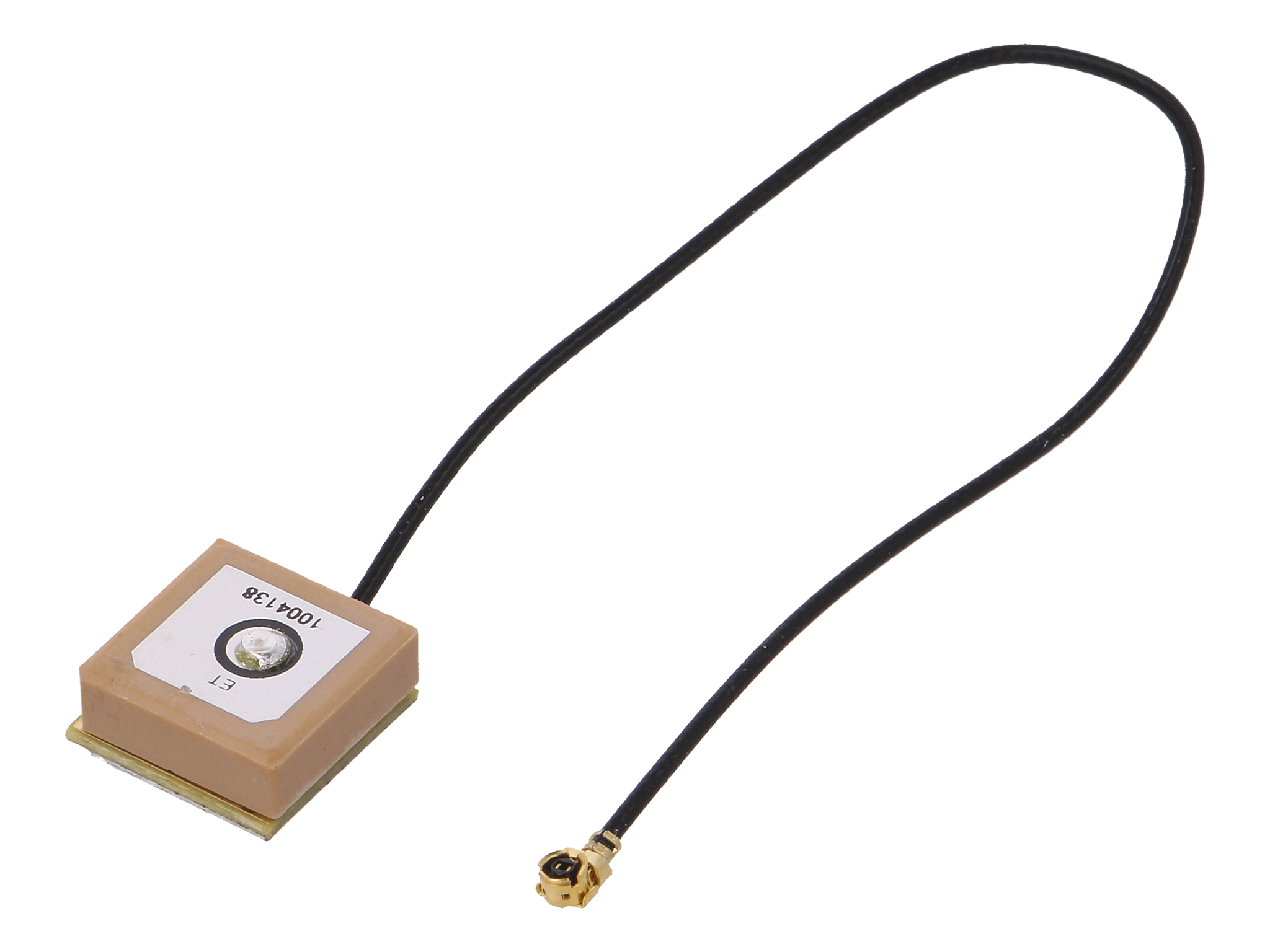
GPS antenna with an LNA amplifier and an IPEX (MHF) connector.
As in the case of the previous product category, here too Kyocera AVX supplies antennas manufactured in the form of small SMD components. Such solutions are mainly used in mobile devices. If the space inside the enclosure of your target device allows the integration of a slightly bulkier antenna, you should consider the 1004138 ceramic active receiver, which houses both the antenna and the LNA (Low Noise Amplifier) in a single 13x13x6.8 mm body, thereby guaranteeing excellent reception of satellite signals even in difficult conditions (e.g. inside buildings or vehicles).
Multi-band variants

“Combo” antenna for simultaneous communication using two different standards.
A subcategory of antennas that could not be missing from this list are multi-band ("combo") solutions. These are most commonly applied in systems for monitoring car fleets. Units placed in cars communicate using at least two technologies. Firstly, they acquire data from the GPS system to locate the vehicle and then use the LTE/GSM network to transmit the location information to a server, to a database. Kyocera AVX offers antennas that combine solutions operating at GSM and LTE frequencies in a single housing. They are equipped with SMA connectors and cables (1 m). This makes it possible to place them in a spot that provides good reception and transmission performance. Thanks to the IPX7 rating, they can even be fixed outdoors, e.g. outside the cab of a truck, if required.
GSM/LTE antennas
Applications of GSM and LTE technologies go beyond smartphones and other consumer devices. Internet access that is independent of the local infrastructure (e.g. Wi-Fi) is an essential feature of many IoT devices, especially those for M2M (Machine-to-Machine) communication. Such access is used by environmental conditions monitoring stations, components of urban installations (street light controllers, traffic sensors). For some devices, the capabilities of standard GSM communication are sufficient to fulfil their role. This would be the case, for example, of intrusion prevention systems, which send a text message in the event of unauthorised access to a restricted area.

Kyocera AVX LTE antennas can be as thin as 0.2 mm.
Kyocera AVX GSM/LTE antennas come in several formats. Besides SMD components (49.6x8x3.2 mm), products enclosed in a housing, equipped with a connecting cable; rigid antennas mounted in an SMA socket, and plastic-coated radiators with a thickness of less than 0.2 mm are available. The latter feature a connection cable equipped with the popular U.FL connector, which can be found in numerous communication modules. The range of those products includes antennas operating at various LTE channel bandwidths, at the lowest (starting from 690 MHz) and high frequencies (up to 2.7 GHz).
RF antennas

Prototype demo board equipped with an SMA connector and an SMD antenna.
Finally, let's take a look at antennas dedicated to RF applications, i.e. short-range communications (remote controllers, remote switch controllers, etc.). Modules of this type operate at ISM bands (Industrial, Scientific, Medical), the frequencies of which vary and depend on the applicable national regulations. SMD antennas from Kyocera AVX are adapted for two frequently used bands: 863–870 MHz and 902–928 MHz. The components feature an energy gain of 0.75 dBi.
Also in this category, the supplier offers prototype PCBs equipped with an SMA connector and a pre-installed antenna.
Leica Geosystems lancerer GS05

Leica Geosystems lancerer GS05 – en ny smart GNSS-antenne, letvægt og med hældningskompensation
En ny smart GNSS-antenne, letvægt og med hældningskompensation
Leica Geosystems lancerer GS05 - en ny smart GNSS-antenne, letvægt og med hældningskompensation
Intergeo, den verdensførende messe for geospatiale løsninger, fandt sted i Stuttgart den 26. september 2024.
På messen præsenterede Leica Geosystems, en del af Hexagon, deres nye Leica GS05 – en smart og let GNSS-antenne med hældningskompensation, designet til at gøre dataindsamling både enklere og mere effektiv.
Med en vægt på kun 0,75 kg inklusive batteriet bliver det daglige målearbejde mindre krævende, samtidig med at et robust design sikrer både holdbarhed og pålidelighed i felten.
Hældningskompensationen, på op til 30 grader, kræver ingen kalibrering og gør det muligt at opnå høj præcision uden, at lodstangen behøver at stå helt lodret, hvilket gør arbejdet effektivt og nemmere at udføre, især på svært tilgængelige steder.
"Leica GS05 gør måling mere effektiv og mindre fysisk krævende. I betragtning af det stigende behov for geospatiale tjenester har branchen brug for smartere løsninger, ikke tungere.
I denne nyhed integrerer vi flere af Leica Geosystems innovationer i én enhed, med præcision, alsidighed og brugervenlighed som resultat," siger Bernhard Richter, Vice President Product Management Geomatics hos Leica Geosystems.
Leica GS05 indeholder en række funktioner som 4G, UHF-radio, et internt batteri med 10 timers levetid og hældningskompensation.
Den integreres problemfrit med Leica Geosystems portefølje, herunder Leica Captivate feltsoftware. Leica GS05 fungerer også sammen med Leica totalstationer som en effektiv SmartPole.
Integration med Leica Geosystems eksisterende udstyr og brugernes arbejdsprocesser optimerer effektiviteten yderligere.